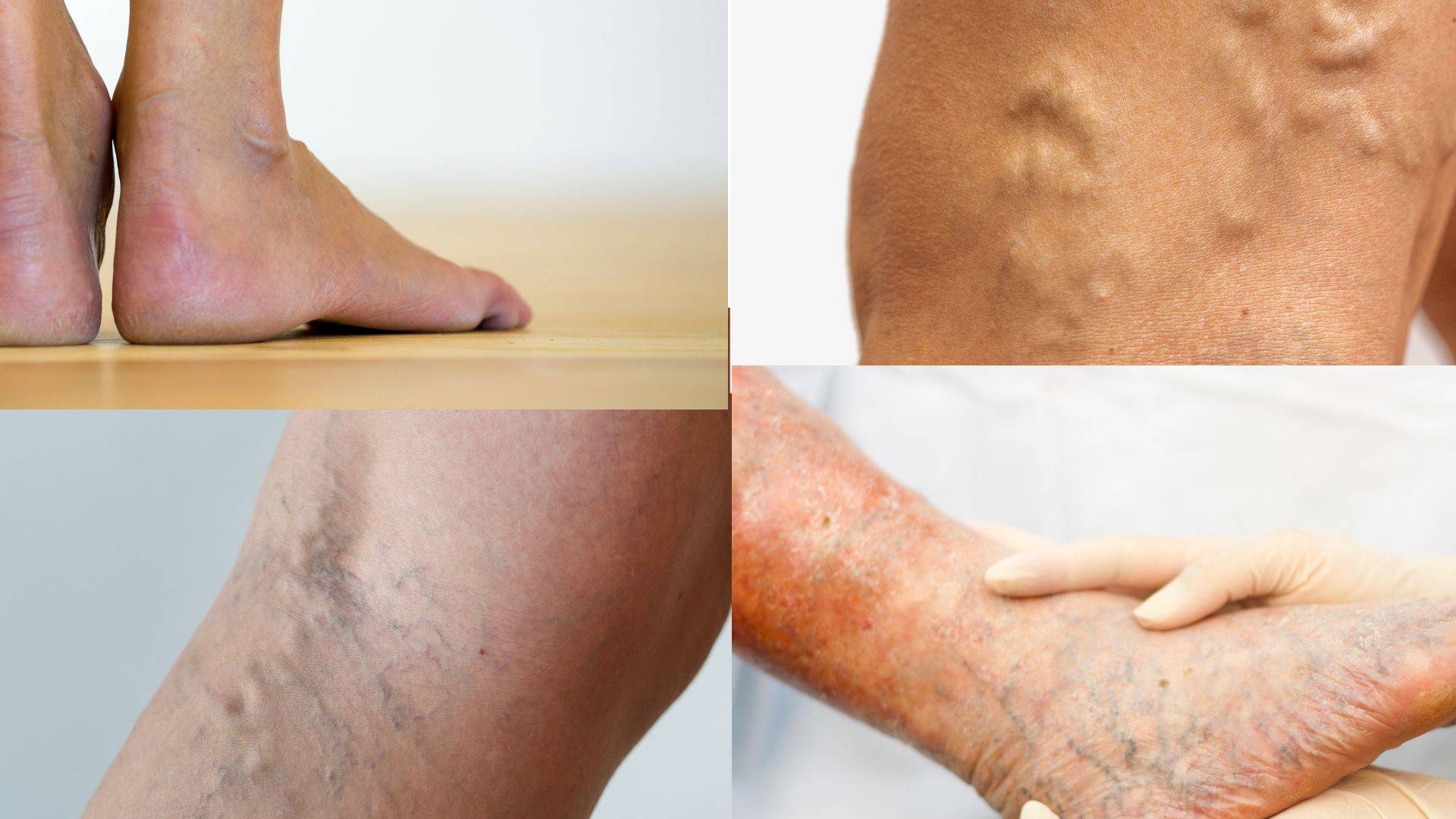
Spider Veins
Spider Veins are tiny, thin vessels near the surface of the skin that appear red, blue, or purple. They often look like fine webs or branching lines.
- Very small (less than 1 mm in diameter)
- Usually flat or slightly raised
- Often cosmetic, but can be associated with burning, itching, or heaviness
- Common in thighs, calves, and ankles
Spider veins are often the earliest visible sign of venous hypertension.
Varicose Veins
Varicose Veins are larger, bulging, twisted veins that occur when pressure continues to build in the superficial venous system.
- Typically >3 mm in diameter
- Raised, rope-like appearance
- May cause pain, heaviness, swelling, or cramping
- Can worsen over time if underlying reflux is untreated
Varicose veins represent a more advanced stage of venous disease compared to spider veins.
How They Are Connected
Both conditions exist on a continuum of venous disease:
- Valve failure begins in deeper or superficial venous segments
- Venous pressure rises (venous hypertension)
- Small superficial vessels dilate → spider veins appear
- Larger superficial veins become incompetent → varicose veins develop
- Progressive inflammation and venous remodeling occur
Importantly, treating only the surface veins without addressing underlying reflux often leads to recurrence.
Symptoms Beyond Appearance
Even though spider veins are often considered cosmetic, both conditions can be associated with functional symptoms of CVI:
- Leg heaviness or fatigue
- Aching or throbbing pain
- Swelling around ankles
- Itching or burning sensation
- Restlessness in legs, especially at night
These symptoms tend to worsen after prolonged standing and improve with elevation or compression.
Bottom Line
Spider veins and varicose veins are different expressions of the same disease process. Spider veins often represent early or mild venous hypertension, while varicose veins reflect more advanced valve failure and vein dilation. Both are strongly associated with CVI and should prompt evaluation of the underlying venous system—not just the visible veins.
You are just seeing the tip of the iceberg.